
Governments and central banks use various economic policies to maintain stability, control inflation, and encourage sustainable growth. Some of these measures include contractionary policies, which are aimed at slowing down economic activity in case of inflation that is too high or the economy starts to overheat. Although these policies could be effective in curbing increasing prices, they can also slow down the growth of the economy when applied too vigorously or over a long duration.
The impact of contractionary policies on businesses, consumers, and investment may assist in explaining why policymakers need to strike a delicate balance between controlling inflation and economic growth.
What Are Contractionary Policies?
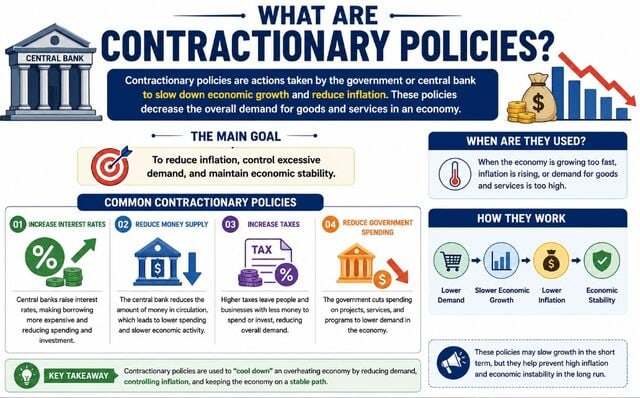
Contractionary policies are economic policies that cause a decrease in the supply of money in the economy. They are usually injected when there is high inflation to reduce consumer spending and stabilize prices.
These policies can be broadly divided into two categories. The central bank of a country controls monetary policy, which can be through raising interest rates or decreasing the money supply. The government uses fiscal policy by cutting down on the amount of public expenditure or increasing taxes.
Why Are Contractionary Policies Used?
Inflation decreases the purchasing power of money and may bring uncertainty to households and businesses. Central banks and governments can implement contractionary policies when prices are increasing at a high rate to lower demand and ensure that inflation does not become hard to manage.
These measures reduce spending and borrowing, which restore economic balance. Despite the main goal of price stability, policymakers are aware that economic growth can temporarily decline within the adjustment period.
Higher Interest Rates Reduce Spending

Raising interest rates is one of the most prevalent types of contractionary policies. The increased cost of borrowing increases the cost of loans to purchase homes, cars, and expand businesses. This tends to make consumers spend less on discretionary purchases and businesses may postpone investment projects.
Reduced expenditure reduces aggregate demand of goods and services. Even though this is useful in alleviating the inflationary pressure, it may also decrease production, slacken business operations, and restrict the growth of the economy.
Businesses Often Delay Investment
One of the significant contributors to economic growth is business investment. When the companies anticipate high consumer demand, they invest in new equipment, technology, research and more workers.
With contractionary policies making borrowing more costly, most businesses delay expansion plans. Less investment may retard innovation, reduce productivity growth, and constrain the creation of jobs, with long-term economic impacts.
Consumer Confidence May Decline
Customers are critical in contributing to economic development by spending on a regular basis. Households tend to be more financially cautious during times of stricter monetary or fiscal policy.
Increased loan payments, higher taxes, or fear of future earnings can make people save instead of spending. Reduced consumer demand impacts retailers, manufacturers, and service providers, and leads to slower economic activity.
Employment Growth Can Slow
Companies that have lower sales tend to change their staffing strategies. Some companies may delay recruitment, reduce working hours, or postpone salary increases until economic conditions improve.
Contractionary policies are not meant to raise unemployment, but the slow pace of business can result in a reduced number of jobs. Increased unemployment may also decrease consumer expenditure, putting further strain on economic growth.
Government Spending May Decrease
Contractionary policies can be fiscal in nature such as cutting government spending on infrastructure, government services or development projects. Although these measures can be used to reduce budget deficits and inflationary pressure, they can also reduce economic activity.
Government projects are known to generate jobs and assist the private business by way of contracts and procurement. A decrease in government expenditure can thus have broader impacts in various sectors.
Balancing Inflation and Economic Growth
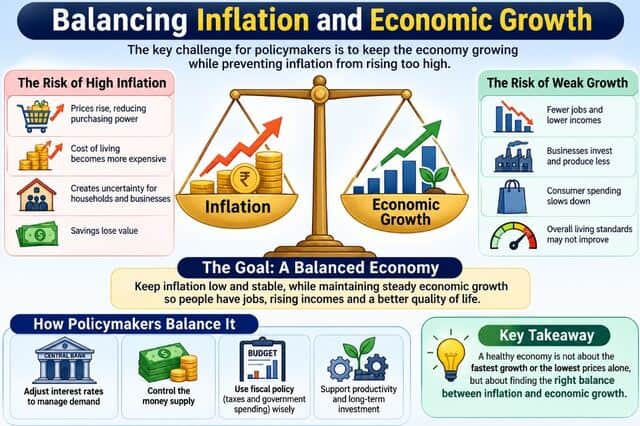
Although contractionary policies have short-term impacts, they are significant in ensuring economic stability in the long run. Inflation that is not controlled may harm the purchasing power, investor confidence and create uncertainty that is equally detrimental to growth.
The dilemma of policymakers is when and how strong these measures should be. When policies are excessively restrictive, economic growth can decelerate to an unwanted rate. In case they are too weak, the inflation can be persistently high.
Factors That Influence Their Impact
The contractionary policies are effective under a number of economic conditions, such as:
- The severity of inflation.
- Consumer and business confidence.
- Employment levels.
- Global economic conditions.
- Government fiscal position.
- The rate of policy implementation.
Due to the fact that each economy is unique, policymakers scrutinise economic data keenly before making significant decisions.
Conclusion
Contractionary policies are necessary in regulating inflation and ensuring stability in the economy. However, they can also slow economic growth by reducing consumer spending, limiting business investment, lowering employment opportunities, and decreasing overall demand. The major issue is to strike the optimal balance between maintaining inflation and long-term economic growth. When implemented carefully and adjusted according to changing economic conditions, contractionary policies can help create a more stable environment that supports sustainable growth while preventing excessive inflation.